
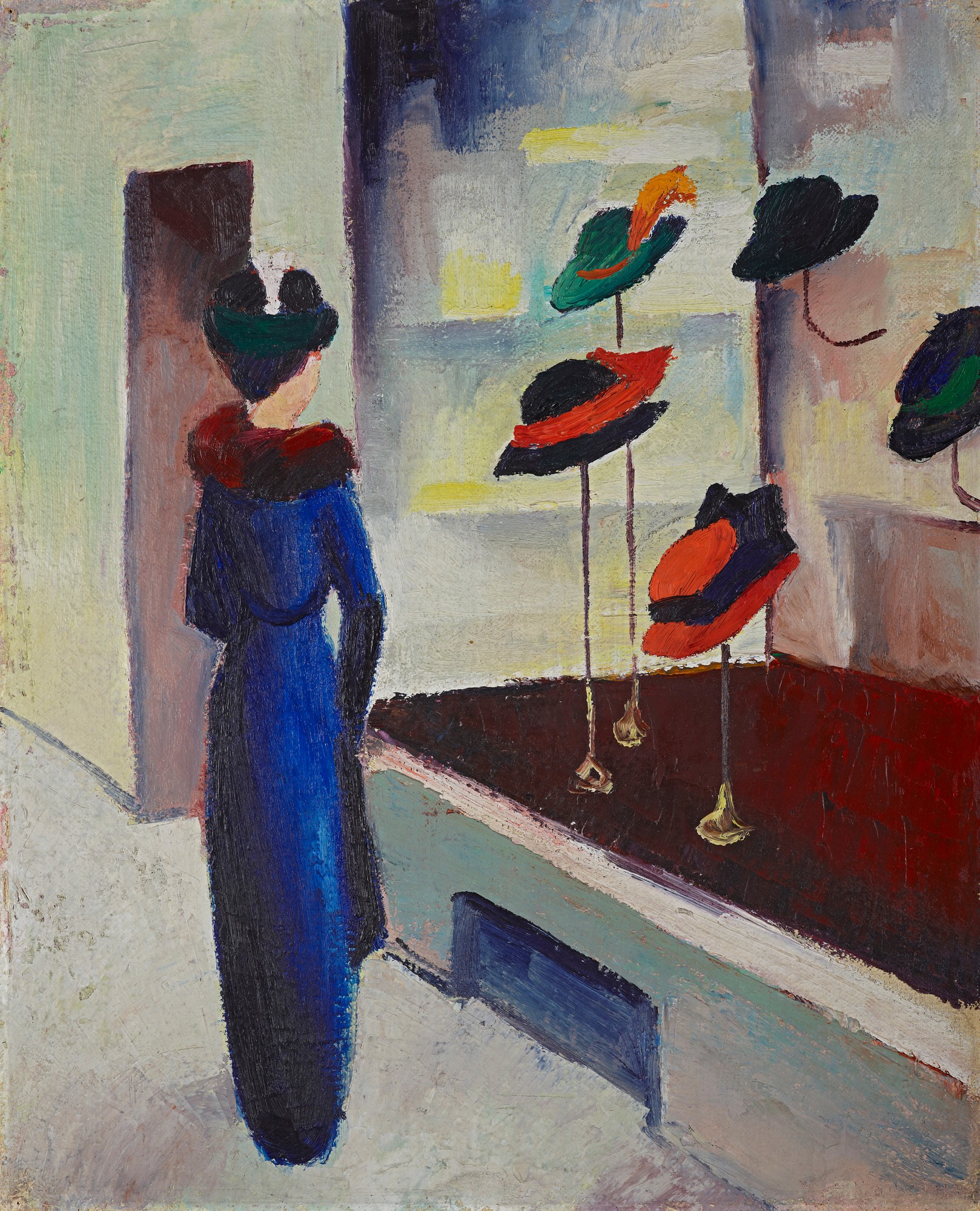
Artist: August Macke
Year: 1913
Medium: Oil on canvas
Macke first introduced the motif of a woman standing in front of a store window into his painting in his important work “Large Bright Store Window” from 1912 (Sprengel Museum, Hanover). At that time, he drew directly on the example of the Italian Futurists—and here particularly on Umberto Boccioni’s painting “La strada entra nella casa”—by placing the figure of a woman seen from behind in front of the colored glass of a store window, in whose facets the activity on the street was reflected. With the series “Hat Shops and Fashion Boutiques,” created in 1913 and 1914 along the promenade and in the arcades of Hilterfingen, the shop window paintings took on particular significance in his mature work.
In between lies his encounter with Robert Delaunay’s “window paintings.” These paintings, in which Delaunay repeatedly depicted the Eiffel Tower—broken down into colored rhombuses—as seen through a reflective windowpane, and used their “simultaneous” contrasts to explore the colors’ inherent movement, expressed for Macke a “downright heavenly joy in the sun and in life.” Enthusiastically, he wrote to his uncle Bernhard Koehler, whom he persuaded to purchase Delaunay’s “Fenêtres 2”: “I’ve just received a reply from Delaunay. I’ve been thinking about it almost constantly lately. Reflective window panes through which, on a sunny day, you can see the city and the Eiffel Tower—the deep-purple reflections, the magnificent orange on the left, the pale-blue houses below, from which, time and again, overshadowed by the sharply defined gleam of the pane, the green tower rises steeply into the azure sky … “You really must see for yourself how, as you walk further away, the colors take on a wonderful depth. It’s all so beautifully balanced that the whole of sunny nature is reflected in it…”
Yet in the “hat shop” in Hilterfingen, the motif of the woman standing in front of a storefront window has solidified in a very idiosyncratic way into a moment of stillness of almost magical concentration. The slender silhouette of the woman, seen from behind, stands upright in a rich royal blue robe with blackish undertones in front of a hat shop’s display window. Like precious talismans, the hats on display on their golden rods present themselves to her. They radiate a mysterious life that captivates the viewer. The windowpane, on the other hand—the element that both separates and connects them—is barely hinted at, so the subtle separation of the visual planes is also absent. Only the yellow and violet angles are reminiscent of Delaunay’s reflective prisms. In these paintings, the French artist’s experiments helped Macke to recast his visions into the precise order of intense colors, thereby lifting them out of the flow of phenomena and fixing them in place. “As if, in this pausing and then immediately moving on again, the experience of transience … had revealed itself to him,” writes Ilse Erdmann in a letter to the poet Rainer Maria Rilke about Macke’s late paintings.
Text from: Friedel, Helmut; Hoberg, Annegret: Der Blaue Reiter im Lenbachhaus München. Prestel Verlag, 2007.
Source (translated from German)
